
“You get what you pay for” applies to domains too. Many registrars and new extensions use rock-bottom prices to attract customers. But these promotions are a double-edged sword: spammers snap up cheap domains in bulk. The result: the reputation of these domains and registrars takes a serious hit, and that damage can end up hurting your website’s visibility.
Spammers burn through domain names at a staggering rate. The moment a domain lands on a blacklist and starts having delivery problems, they move on to the next one. No surprise, then, that spammers always hunt for the lowest price. Quality is the last thing on their checklist.
When new domain extensions launched, some went with aggressively low (or even zero) pricing to drive registrations. What they didn’t anticipate was that a significant share of those registrants would be spammers. The consequence: the proportion of new domains used for malicious activity is on track to exceed other domain types in absolute terms, as documented in the NAMESENTRY abuse report for June. 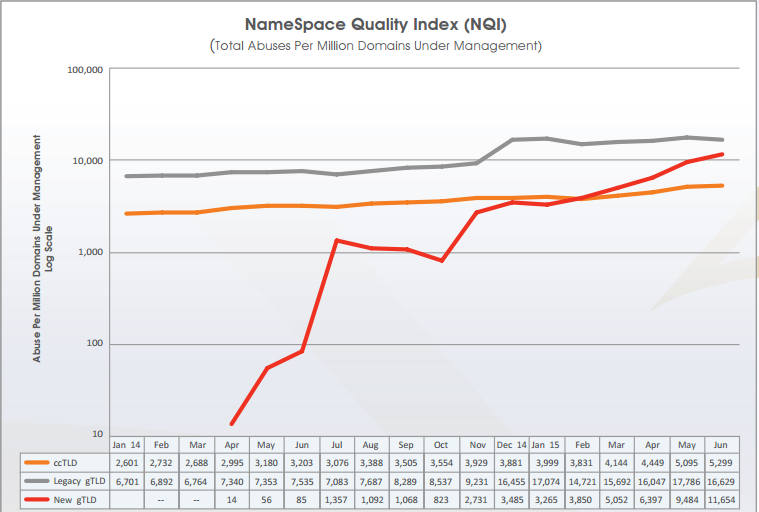 Source: The NAMESENTRY Abuse Report
These practices are taking a toll on domain reputation. Domains and registrars disproportionately used for shady purposes get flagged by search engines and other companies as untrustworthy. The fallout: using a domain or provider with a poor reputation can hurt your website’s ability to appear in search results. Among new extensions, .science, .work, and .xyz are the most heavily exploited by spammers. Some registrars sell these domains for $2 or less. 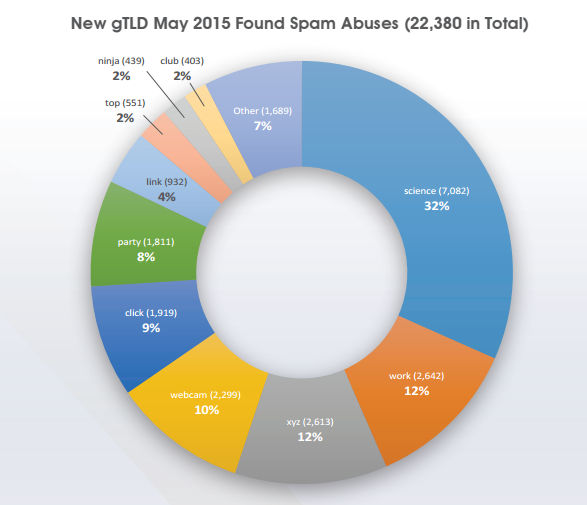 Source: The NAMESENTRY Abuse Report
For a spammer burning through up to 1,000 domains per week, the difference between $2 and $13 is enormous. It’s entirely plausible that search engines are already using domain price as a quality signal. If so, the companies that chose this pricing strategy may have trapped themselves in a vicious cycle that’s very hard to escape. Photo: Graph With Stacks Of Coins by Ken Teegardin, published under Attribution-ShareAlike 2.0 Generic (CC BY-SA 2.0)