
Could .com be hitting its ceiling? .com domains have dominated the internet virtually since its inception. With over 160 million .com domains registered, they remain by far the most widely used extension in the world. Yet in 2023, .com saw a slight dip in the number of registered domains compared to the previous year. Are the winds of change beginning to blow?
More domains overall, but nearly the same number of .coms
According to Verisign’s latest report, Q3 2023 closed with 359 million domains registered worldwide — an increase of 8.5 million domains over the prior 12 months. These figures reflect solid growth in the number of users seeking to establish a digital presence, but they also contain a surprising finding: in October 2023, there were fewer .com domains registered than the year before.
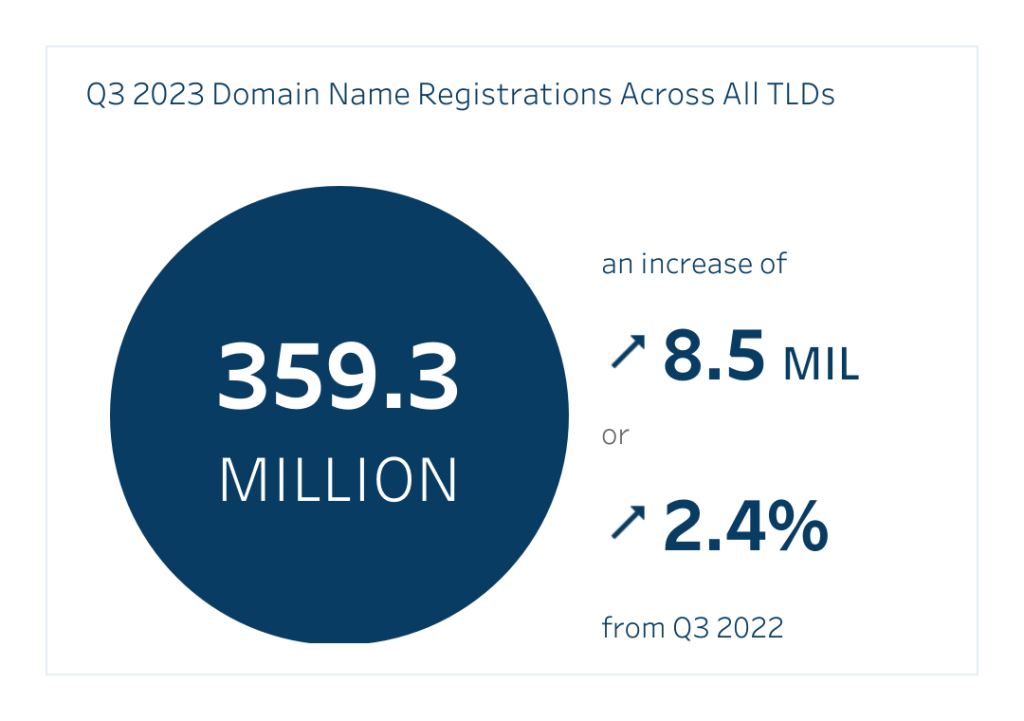
Source: Verisign, Domain Name Industry Brief Quarterly Report
Verisign sources maintain that .com domains remain in strong health, attributing the slight decline (roughly 0.1% of the total) to a sharp drop in .com registrations from China:
Excluding China-based registrars, both our domain name base and new registrations increased during the third quarter compared to the prior year.
Chairman and CEO of VeriSign. Source: marketbeat.com
Notably, .CN is the second most registered extension, though far behind .com. With just over 20 million .cn domains registered, there are approximately 140 million more .com domains than .cn domains. You might expect Chinese users to be switching to their national extension instead, but that’s not the case. .CN registration numbers have been flat since 2016, which suggests the decline has different roots: likely a pullback from bulk registrations by domain investors, or less motivation among Chinese businesses and consumers to build an independent online presence when massive e-commerce platforms already dominate the landscape.
A growing universe of domain options
Meanwhile, the domain name market is clearly trending toward diversification. The increasing difficulty of finding available .com names has pushed more users toward their respective country-code domains (known as ccTLDs), such as .ar, .cl, .es, and others. At the same time, the proliferation of new generic domains (.online, .top, .shop, .app, etc.) — coupled with targeted marketing efforts by their registry operators — is encouraging a growing number of individuals and businesses to adopt them for their online presence.
This shift shows up clearly in year-over-year registration statistics: country-code domains as a group grew by more than 5.4 million (over 4%), while new generic domain registrations increased by nearly 3 million, a 10% jump year over year.
Mixed signals for Spanish-speaking country domains
Despite the strong overall performance of national domains, ccTLDs in Spanish-speaking countries are telling a different story. Of all the Spain and Latin American ccTLDs, only .py (Paraguay) and .pa (Panama) grew above the global average. Given the limited scale of those two extensions, the overall picture for Spanish-language domains is not encouraging.
Among the rest, only .es (buoyed by Spanish government grants supporting the digitalization of Spanish businesses) and .uy appear to be keeping pace with global growth trends, while most Latin American domains are showing signs of stagnation or have actually seen their registration numbers decline in recent months.
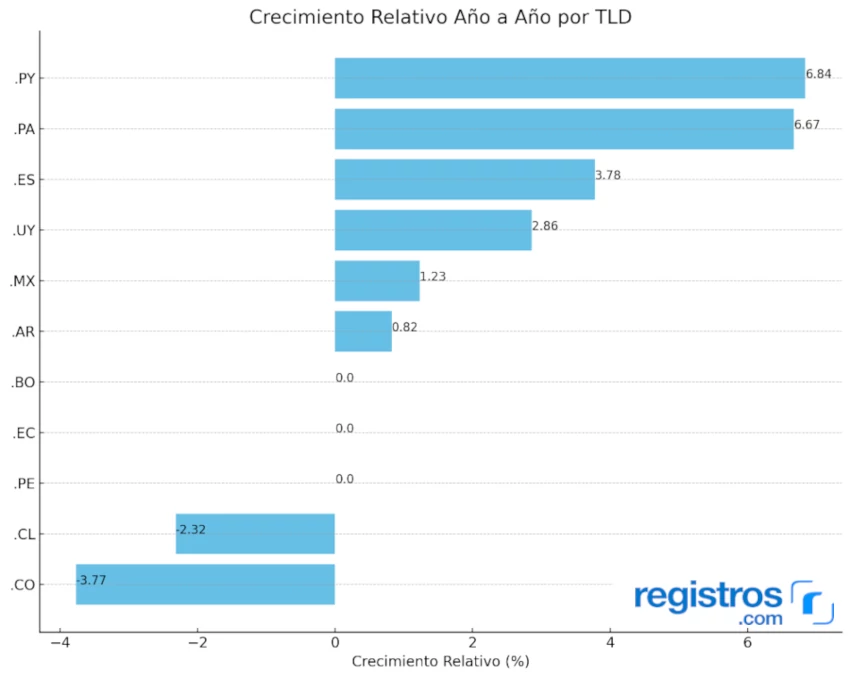
Registration trends for ccTLDs in Spanish-speaking countries (2023). Source: data compiled from the NIC registries responsible for each extension.
Of particular note, .co domains experienced a significant decline — 120,000 fewer registered domains (-4%) compared to the prior year. This likely reflects .co’s dual positioning strategy, marketed simultaneously as a .com alternative and as Colombia’s national domain, which may be exposing it to the same headwinds dragging on .com growth.
Equally concerning is the trajectory for .CL domains. Chile’s domains lost 16,000 registrations in recent months — a drop of nearly 3% in the total number of Chilean domains. Given the nature of this extension, such a decline could signal that the pace of new Chilean internet users coming online is beginning to slow.
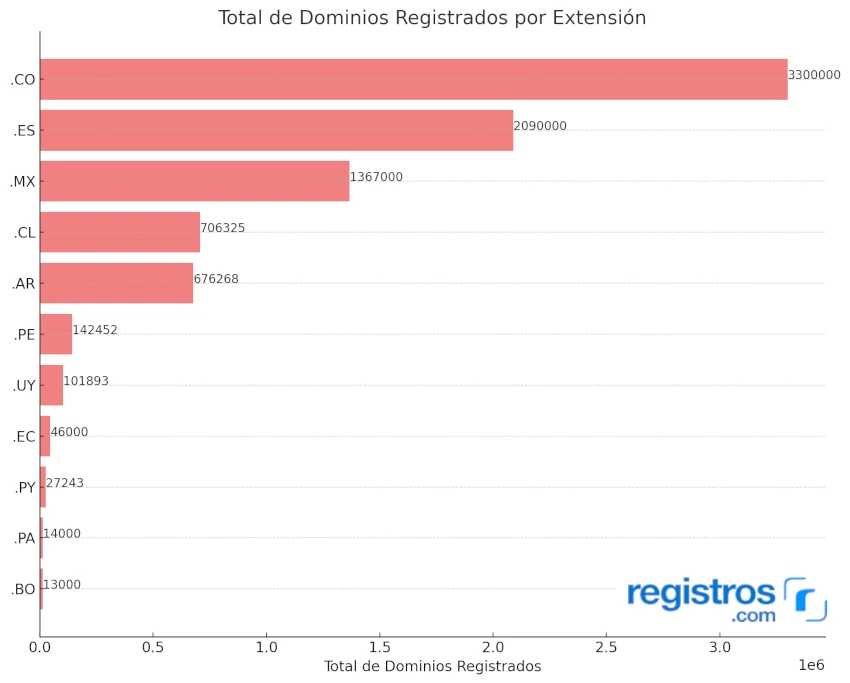
Total domain counts for ccTLDs in Spanish-speaking countries (2023). Source: data compiled from the NIC registries responsible for each extension.
Conclusion: .com stalls as the domain universe expands
.com domains — long the gold standard of internet identity — are showing signs that the market is maturing. The slight dip in .com registrations may point to a degree of saturation: quality .com names are increasingly hard to find, which is fueling the growth of the many alternatives that have emerged or gained traction in recent years, both country-code and new generic extensions.
Spanish-speaking country domains, meanwhile, are slightly trailing the global trend. Only four extensions (.py, .pa, .es, and .uy) are keeping up with worldwide ccTLD growth, while the rest of Latin America’s domains are stagnating or showing signs of contraction — facing the same challenge that .com faces: how to grow again. Yet despite everything, .com remains the undisputed king of domains.