You have a website and it’s time to win customers. But every potential customer is different. Some already love your products, while others don’t even know you exist. The conversion funnel and the sales funnel are tools that help you identify which stage each customer is at and design the most effective strategies to turn interest into sales.
In an ideal world, every potential customer who lands on your website would become a paying customer. But reality is different: the number of people who actually buy your products or services is always smaller than the number who show interest. Think about it — you don’t buy something every time you walk into a store (and if you do, maybe you should be a little worried).
The term “funnel” gives us a visual way to understand the process by which an ordinary user ends up becoming a customer. Picture a large funnel into which you pour a huge number of potential customers. Those who make it out the narrow end are your customers. For the rest, the funnel helps you limit the “leakage” of potential customers — just like a real funnel helps you avoid spilling liquid all over the kitchen counter when you’re trying to fill a bottle.
Conversion funnel vs. sales funnel
We’ve just mentioned both the “conversion funnel” and the “sales funnel” — but do they mean the same thing? Yes and no. Browse around online and you’ll find the two terms used interchangeably. Purists could fill a chapter or two of a marketing textbook debating the difference. But our goal here is to be practical, so we’ll draw a clear line: the conversion funnel describes the process a user goes through from the moment they visit your website until they complete a purchase (or another action you consider important, such as signing up). The sales funnel, on the other hand, covers the full journey from the moment someone first encounters your brand until they become a customer. In other words, the sales funnel is broader and includes activities beyond your website, while the conversion funnel focuses specifically on the purchase process.
What is the conversion funnel?
Completing a purchase on a website involves several steps: visiting the site, reviewing a product or service page, adding items to the cart, entering your details, reviewing your order, and finally paying. At each of these steps, some users abandon the process — which means that if you chart the number of users reaching each stage, you get the shape of a funnel:
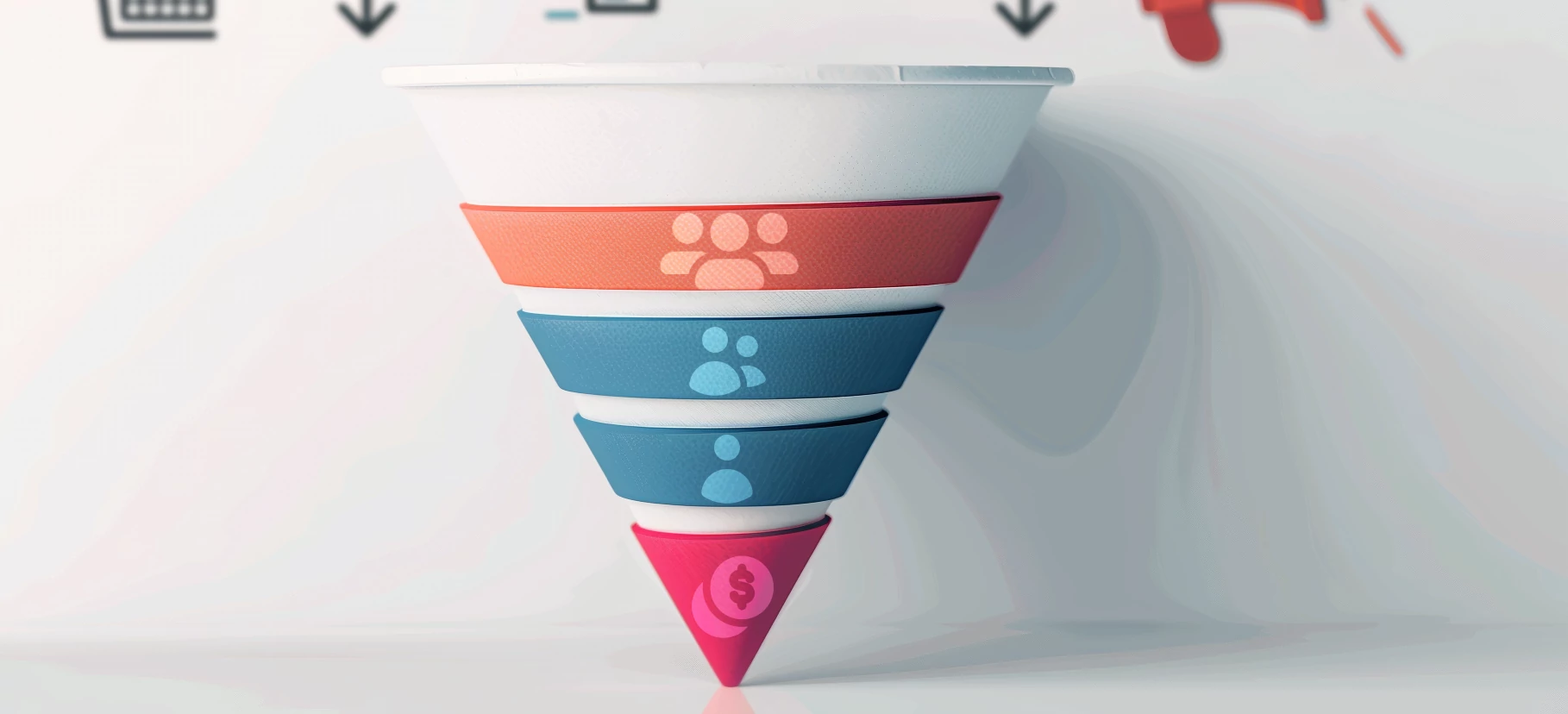
Identifying each of these steps and analyzing user behavior at each one allows you to spot problems or opportunities for improvement in your purchase process and increase the number of completed transactions on your site. This practice is known in online marketing as “conversion rate optimization,” or more commonly, CRO (Conversion Rate Optimization).
Drawing a parallel with the real world, the conversion funnel begins the moment you walk into a store intending to buy a pair of jeans. Once inside, you need to find the jeans section and pick a pair in your size. Then you head to the fitting room to try them on. If they fit well and nothing distracts you or makes you second-guess yourself, you walk to the register to pay. Done — new jeans.
In that example, it’s easy to imagine reasons why you might leave empty-handed. Maybe you don’t like any of the styles, your size isn’t available, or there’s a long line for the fitting rooms. The same applies to a website. Factors like a slow site, lack of product information, confusing payment or shipping details, and other friction points can significantly impact your sales. Analyzing your conversion funnel lets you identify these issues and fix them, increasing the percentage of users who complete the purchase. The payoff is real: even a 1% improvement in your overall conversion rate can mean doubling your sales.
What is the sales funnel?
The sales funnel starts before a potential customer even knows you exist — it spans from the moment they first encounter your product or brand all the way through and beyond their conversion into a customer.

Going back to our earlier example, imagine this scenario. You’re walking down the street, lost in your thoughts, when you pass by a clothing store window displaying a mannequin in a pair of jeans on sale. “I need new jeans,” you think. From that moment, the story can take several different turns:
- You walk straight in and buy the exact pair you saw in the window because you love them. And somehow, you walk out with two blouses, three shirts, and four pairs of socks.
- You go in just to check the price and see if anything else catches your eye. Then you head out for coffee with a friend. A few days later, you go back and buy one of the pairs you tried on.
- You realize — as always — that you’re running late for work. A week later, you remember you wanted jeans and, being the seasoned shopper you are, you visit several stores before finding the perfect pair.
- You take a few more steps and suddenly wonder: what was it I needed? After a moment’s thought, you decide it couldn’t have been that important and smile to yourself — “typical me.”
Each of these stories illustrates different priorities and behaviors when it comes to buying something (in this case, jeans) and reflects different moments in what marketers call the “customer journey.” The sales funnel maps each of those moments and helps you develop strategies to guide someone who’s interested in your products all the way to becoming a customer.
Differences between the conversion funnel and the sales funnel
The main difference between the two is scope: the conversion funnel focuses on turning website visits into sales, while the sales funnel aims to capture and convert prospects into long-term customers through a broader process.
The sales funnel encompasses the conversion process on your website as well as all interactions that occur outside of it: advertising, emails, phone calls, and more. And unlike the conversion funnel, the sales funnel doesn’t end with the purchase — it also aims to ensure customer satisfaction, foster loyalty, and encourage future purchases.
When working on the conversion funnel, the task has two main components:
- Providing customers with the right information about your products and services.
- Removing barriers to make the purchase as easy as possible (for example, minimizing required form fields or offering a simple return policy).
Improving the sales funnel, on the other hand, requires designing effective communication strategies for each stage of the customer journey.
Stages of the conversion funnel
The conversion funnel can take many shapes depending on your products and goals. One of the most common models breaks the process down into four stages: visit (or contact), interest, purchase intent, and transaction (or conversion).
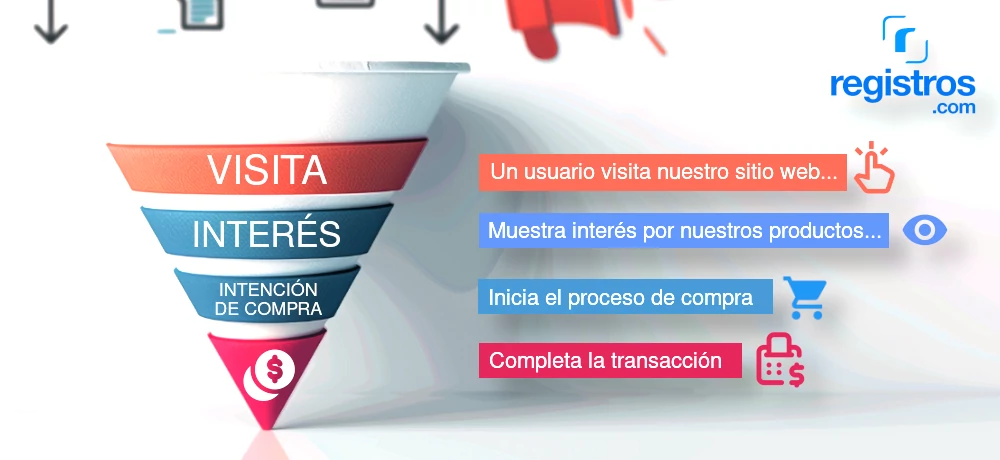
Visit: the moment a user first reaches your website.
In our jeans example, this stage begins the moment you step through the store’s door.
Interest: the user shows a clear signal of interest in your offerings — for example, by spending time on a specific product page, requesting a case study, or asking for a free sample.
You head to the jeans section looking for a specific style or size, and if a sales assistant sees you browsing with a puzzled look, they’ll probably come over and ask if you need help.
Purchase intent: the user initiates a buying process. In an online store, this is the moment they add a product to their cart. For other types of services — a dance school, a software company, a consulting firm — purchase intent might be expressed by making a phone call, contacting the sales team, or requesting a demo.
You’ve come out of the fitting room and you’re walking purposefully toward the register. Those jeans hanging over your arm are exactly what you were looking for.
Transaction: the moment the deal is closed — via payment, signing a contract, and so on.
Done. You’ve paid, and the jeans that a few moments ago belonged to the store are now yours. Mission accomplished.
Each of these stages can be broken down further to pinpoint more precisely where a customer stands within the conversion process. For instance, a user who has registered on your site and reviewed their order is more likely to complete the purchase than one who has simply added a product to their cart. The insights gained from this analysis give you a clearer picture of where obstacles exist in the purchase process — so you can remove them.
Stages of the sales funnel
The traditional framework for structuring the sales funnel is the AIDA model (Awareness, Interest, Desire, Action). This model breaks the customer journey into four stages:
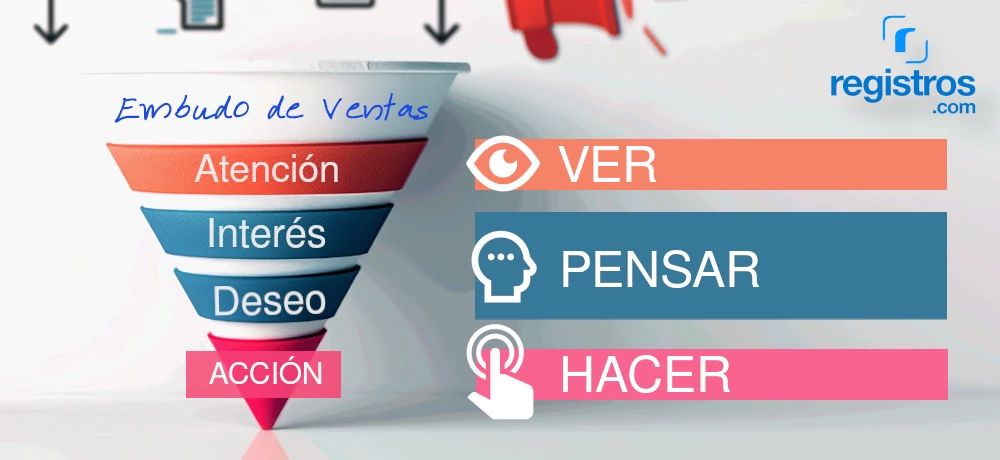
AIDA model compared to the See – Think – Do model
Awareness: It’s hard to buy something you haven’t thought about (like forgetting to grab onions at the supermarket) and even harder to buy something you don’t know exists. That’s why the first goal of any marketing campaign is to draw attention to a brand or product.
In our example, the awareness stage corresponds to the moment we spot the jeans in the shop window — sparking the whole process of deciding whether to buy them.
Interest: Beyond catching our attention, a product or service also has to capture our interest — whether because it’s appealing or because it addresses a genuine need. At this stage, marketers typically focus on highlighting a product’s benefits and explaining how it can solve the customer’s problem.
This is the moment you walk over to the jeans rack to get a closer look — feeling the fabric, checking the price, reading about the materials.
Desire: The line between interest and desire can be blurry, as both often happen at the same time. The key difference is that in the desire stage, you have a strong pull toward buying the product and the only things standing in the way are logistical (not enough time) or financial.
You’re in the fitting room, and let’s be honest — these jeans look great on you. You start imagining yourself striding down the street in slow motion as heads turn… A sound snaps you back to reality. Time to pay.
Action: The moment of the transaction, where the sale is completed. The key objective at this stage is to make the purchase process as frictionless as possible and remove any last-minute doubts that might lead the customer to walk away.
You head to the register, which is fortunately free. Time to pay — but where’s your wallet? Ah, wrong pocket. The jeans are yours.
In addition to the AIDA model, there are other ways to describe the conversion funnel — such as the “See, Think, Do” model, which essentially describes the same process in simpler terms. Online marketers also commonly use the expressions “top / middle / bottom of the funnel.” The top corresponds to the awareness (See) stage, the middle to interest and desire (Think), and the bottom to action (Do).
How to measure conversion and sales funnels in online marketing
After reviewing the sections above, you should have a good idea of the key actions in your conversion and sales funnels. To measure their effectiveness, you’ll need to identify metrics tied to those key actions. This will tell you how many users reach each stage and where you have the biggest opportunities to improve your customer acquisition process.
The metrics that define the key aspects of your funnels are called Key Performance Indicators, or KPIs. Let’s look at some of the most commonly used indicators for measuring conversion and sales funnel performance online.
Measuring the conversion funnel
As we discussed earlier, the conversion funnel tracks user behavior within your website. Measuring it is relatively straightforward, especially if you’re already using a web analytics tool such as Google Analytics 4. The most commonly used metrics for each stage are:
- Visit (general interest in your website): total visits, unique visitors (the number of distinct users who have visited your site), new users (the number of users visiting for the first time within a given period), etc.
- Interest (specific interest in a product): number of visits or unique visits to a specific page (such as a product or service page) and average time on page. For some project types, interest can be measured even more precisely when a user actively requests more information — by contacting your sales team, requesting a case study, or registering on your site.
- Purchase intent: number of products added to the cart (for e-commerce), contacts with the sales team (by email, phone, etc.), quote requests, product trials, etc.
- Transaction: number of sales, contracts signed, etc.
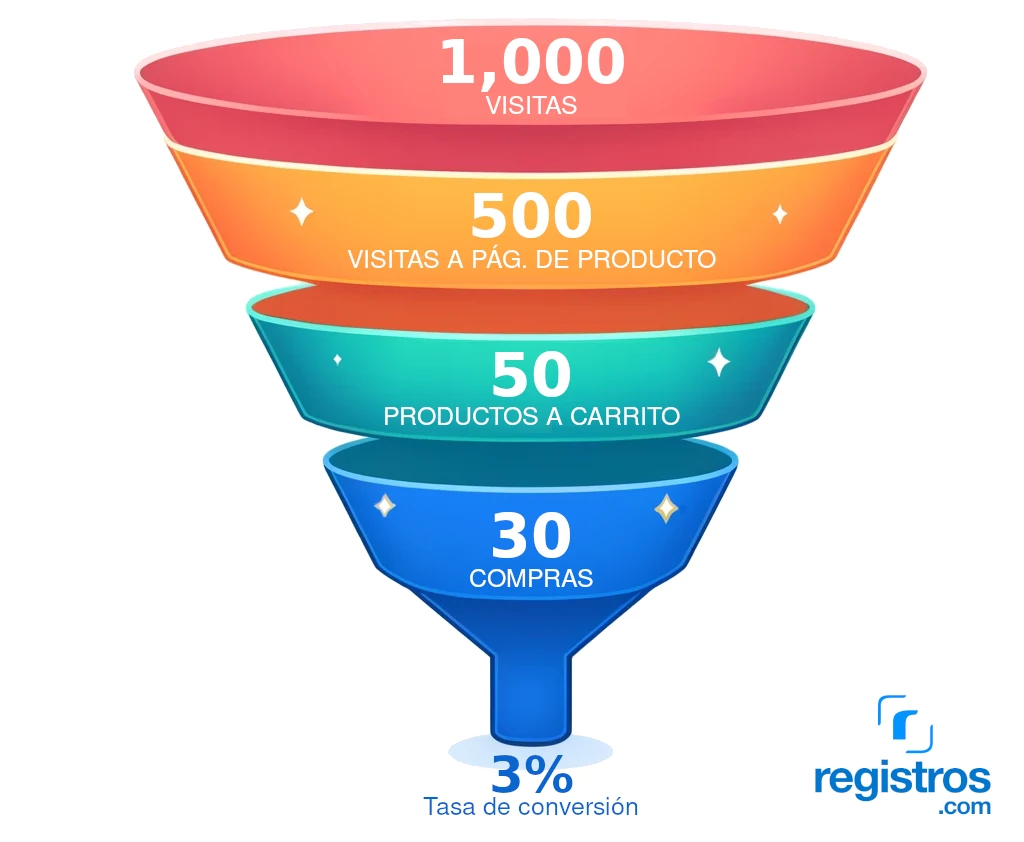
Example of a conversion funnel
Measuring the sales funnel
The sales funnel includes all conversion funnel metrics plus some additional ones that describe the stages before a user’s first visit to your website:
- See (Awareness): metrics that evaluate a brand’s or product’s visibility by quantifying how many times users have been exposed to your offerings — even before visiting your site. This stage focuses on metrics such as: ad impressions, complete video ad views, users reached by social media messages, number of brand-related searches, etc.
- Think (Interest / Desire): at this stage, the user takes an active role, and the metrics used focus on measuring their level of engagement based on their actions. Relevant metrics include ad clicks, newsletter sign-ups, participation in online events, or the number of free content downloads.
- Do (Action): metrics at this stage give a picture of customer behavior during the purchase process — such as the rate of users who add products to the cart, number of product inquiry forms submitted, calls to the sales department, and of course, the number of purchases completed.
How to use conversion and sales funnels
Now that you have all the information you need, it’s time to put it into practice. There are two fundamental ways to work with conversion and sales funnels. The first is to optimize your processes to drive more sales — which requires analyzing user behavior at each funnel stage and then implementing actions to eliminate doubts or purchase barriers. The second is to design strategies to reach users at each stage and keep them engaged throughout the buying process.
The first step when working with funnels is to identify the key actions your users take on their way to becoming customers, quantify them with the right metrics, and then map the funnel visually.
Once you’ve built your funnels, the first thing that will catch your attention is how many users drop off at a particular point (the perfect conversion funnel doesn’t exist) — and then you’ll start asking yourself: 1) what might be causing those drop-offs, and 2) how can I fix it? Congratulations — without realizing it, you’ve just become a CRO specialist.
The next step is more sophisticated, as it involves asking yourself how to attract new customers and guide them effectively toward a purchase. That means considering what information a user needs at each stage of the process and what the best moment is to deliver it.
Both optimization and acquisition are ongoing processes that help you understand your users better and roll out increasingly sophisticated strategies over time. Conversion and sales funnels are also invaluable for spotting shifts in user behavior and for thinking of new ways to solve problems or seize opportunities at each stage. And although the word “funnel” implies a downward flow, marketing funnels — when used well — can be powerful tools for propelling your project upward.