Google Ads is Google’s advertising platform. Through it, you can create and publish ads both in Google Search and across other Google partner sites.
You’ve almost certainly noticed the ads that appear at the top of your Google search results. You’ve probably wondered: how much do they cost? Do they actually work? How do you create one? Could something like this work for my business? If you run a business or digital project and want to reach more people online, Google Ads is a great place to start.
Google Ads (originally called “Google AdWords”) is Google’s solution for monetizing its search engine through advertising. Every time a user performs a search, Google gives advertisers the opportunity to display their ads in exchange for a payment per click received.
What makes Google such a compelling advertising channel is that your ads only appear in front of people who are actively searching for something related to what you offer. This is known as “contextual advertising” — rather than showing the same ads to everyone, Google serves different ads for each search and each user profile.
What is pay-per-click?
Google AdWords quickly became one of the leading pay-per-click (PPC) advertising platforms. Pay-per-click is an advertising model that allows advertisers to pay only when someone clicks on their ad — in other words, for each visit they receive to their website.
The pay-per-click model has grown increasingly sophisticated over time. Today, Google Ads offers a variety of other pricing models for ads distributed through its platform. Some of the most common are:
- Cost-per-click (CPC): the advertiser pays when users click on their ads.
- Cost-per-thousand impressions (CPM): the advertiser pays a set amount for every 1,000 times their ad is shown.
- Cost-per-acquisition (CPA): the advertiser pays when a defined goal is achieved (completing a sale, generating a lead, getting an app download, etc.).
PPC is widely used in digital marketing because, beyond paying only for real results, it lets you optimize your campaigns, target specific audiences, and control exactly how much you spend.
The impact of pay-per-click on online advertising
The pay-per-click model has had a profound effect on how advertising works — and on digital marketing in particular. Built from the start around concrete metrics (like clicks received), the evolution of Google Ads (and similar platforms) has always been closely tied to an ever-growing ability to measure and evaluate return on ad spend.
In recent years, thanks to refined algorithms and AI, Google has been moving away from pure pay-per-click models toward ones that align more closely with the business metrics advertisers actually care about. While Google’s systems still fundamentally operate on a cost-per-click basis, they now focus much more on hitting the profitability or customer acquisition targets set by the advertiser. Profitability targets use a metric known as ROAS (Return on Ad Spend) — the revenue generated for every $1 invested in advertising. Customer acquisition costs are defined using CPA (cost-per-acquisition), which we covered above.
What is Google Ads and how does it work?
Google Ads is Google’s advertising platform that lets your brand appear at the top of search results without needing to implement a complex SEO (search engine optimization) strategy for your website.
Achieving strong organic rankings in Google can be a monumental task. Reaching the first page can take months of sustained effort — with no guarantee of success.
Google Ads offers a shortcut: it gets your site visible far more quickly through a paid system. Every time someone performs a search, Google Ads runs an auction among ads that match that query. But unlike a typical auction, the top spot doesn’t necessarily go to the highest bidder — it’s awarded based on a combination of how much the advertiser is willing to pay (the bid) and how relevant the ad is for that particular search.
Where do the ads appear?
Google Ads typically shows ads at the top and bottom of search results pages — but Google now offers a wide variety of advertising channels. Beyond standard search results, Google Ads can also appear in Google Shopping, YouTube, Google Play, Google Maps, Google Images, and more.
And that’s not all. Google has a network of partner sites that extends the reach of your ads even further, giving you access to an enormous potential audience.
What is Google Ads used for?
Google Ads promotes your brand, product, or service across the Google network and its advertising partners. In plain terms, it helps you boost your online presence and connect with the people who are genuinely interested in what you offer.
With Google Ads you can drive more customers to your business and increase the visibility of any type of project. Image and video formats also allow you to promote your brand and products, helping potential customers grow familiar with and trust your business.
Is your project still in its early stages? You can use Google Ads to generate traffic or sign-ups, or even to test whether your product has real market demand. This is hugely useful for entrepreneurs exploring new territory — you’ll quickly see from real data whether people are interested in what you’re offering. And if they’re not, you’ll have saved yourself a significant amount of time and money.
Advantages of Google Ads over organic search
“Is it better to invest in Google Ads or put in the effort to rank organically for free?” The honest answer is: both. The more visibility you have, the more opportunities you’ll have to connect with your audience. Paid and organic channels have distinct characteristics, and each offers specific advantages.
”Paid” doesn’t always mean more expensive
The most obvious advantage of organic search is that it’s free — or rather, the clicks from “natural” search results don’t cost money directly. However, ranking high in search engines does have a cost: the time and effort it takes to get your website to a position that generates meaningful traffic. The more competitive your industry, the harder you’ll have to work for any results — and even then, success isn’t guaranteed. There are many factors outside your control: Google’s own algorithm, your competitors, and so on. That said, once you achieve a strong ranking, you secure a certain level of organic traffic to your site, and while you still need to work to maintain it, the ongoing effort is less than starting from scratch.
Greater control over the risk you take on
With Google Ads, every click costs money — but instead of betting on a strategy with an uncertain outcome, you’re paying for actual visits to your website. Once a user arrives, you control what you offer and how you guide them toward your goal. This gives you much more control over your investment and risk. Advertising guarantees visits you can work with to make your investment pay off, and it lets you choose exactly which messages to promote, who you want to reach, and when. With the right decisions and execution, advertising stops being an expense and starts generating revenue.
Visibility at two different speeds
Speed is one of Google Ads’ biggest advantages over organic search. In the world of SEO, working 3 to 6 months ahead — or sometimes a full year — is standard practice. That timeline, however long it may seem, reflects how long it takes for search engine optimization work to translate into visible results. Creating an ad through Google Ads, by contrast, takes just a few minutes and can start delivering visits immediately.
Google Ads gives you insights to improve your project
But Google Ads offers something even more valuable than quick access to customers: data. Whatever your goal, the information Google Ads provides is invaluable. Beyond revealing which keywords generate the most traffic and sales, Google Ads shows you how to present your services most effectively and which user profiles are most interested in your products. This data helps you refine your website or physical business, and it’s enormously useful for shaping your search strategy — giving you advance insight into the most relevant search terms for your project.
When launching a product, business, or any new project, a common practice is to run a small ad campaign to test whether potential customer behavior matches your expectations. The data from Google Ads then lets you refine your product or service to make it easier to sell effectively.
It’s easier to get your campaigns up and running
One aspect that’s often overlooked when comparing Google Ads to organic search is the sheer complexity of each strategy. As noted earlier, you can create a Google Ads account and start running ads in under half an hour. Achieving strong organic rankings for a given search term, by contrast, gets exponentially harder the more competitive that term is. Getting to the top of Google requires working on multiple factors both on and off your website: its structure, content, usability, and overall reputation online.
Managing Google Ads campaigns can also grow more complex as you and your competitors get better at using the platform. That said, getting a basic Google Ads campaign up and running is far simpler than executing an effective search marketing campaign.
For obvious reasons, Google has a strong interest in attracting as many advertisers as possible and goes to great lengths to make it easy for newcomers to get started on its platform. In recent years, Google has rolled out a number of features that lower the barrier to entry and reduce the effort required to run effective ad campaigns through Google Ads — automating everything from ad creation to deciding how much to pay for each potential customer that lands on your website.
Paradoxically, Google’s push toward automation has made campaign management technically more complex, mainly for two reasons: automation algorithms require a minimum volume of data that many advertisers never reach, and the reduction in options and controls demands more sophisticated techniques to optimize the campaigns. That’s why many businesses turn to an agency or a digital marketing consultant to avoid being left at the mercy of Google’s judgment — given that Google has a clear incentive to extract the maximum value from each advertiser.
Finally, the data you get through Google Ads is far more detailed and arrives far faster. That gives you better tools to identify what’s working and improve your results more quickly.
The importance of being seen
In the past, landing one of the top three positions on Google was a near-guarantee of capturing the lion’s share of clicks for a given keyword. Over time — driven by the goal of increasing revenue — Google has steadily expanded the space it devotes to advertising.
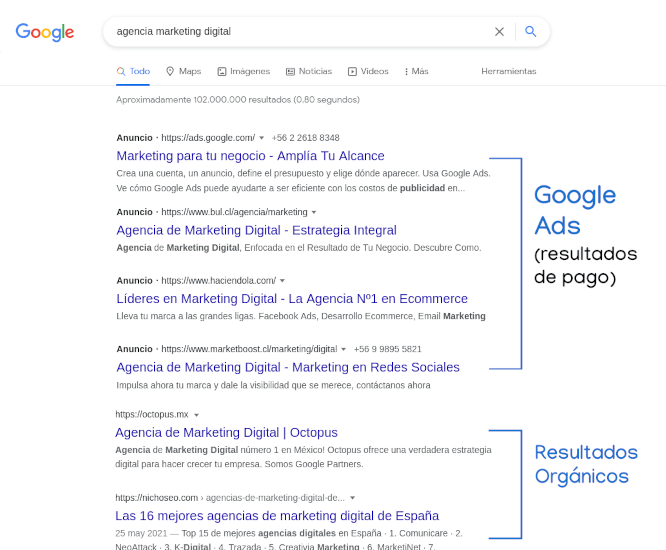
Today, when you search on Google, you’ll often find that half (or more) of the visible screen before scrolling — the area known as “above the fold” — is taken up by ads, with the first organic result appearing only at position five or lower. This has dramatically reduced the ability of organic results to generate traffic, a trend that’s only been compounded by Google’s increasing tendency to blur the visual distinction between ads and organic results. So much so that, according to some estimates, between 30% and 50% of users cannot tell the difference between a paid ad and an organic search result.

Nearly identical: a Google Ads ad versus an organic search result.
Through these changes, Google has effectively pushed more and more businesses onto its advertising platform. Organic results now represent only a fraction of the total visibility available through Google. For most businesses, advertising through Google Ads has become less of a choice and more of a necessity. The challenge: making sure that investment pays for itself.