
Online marketing professionals love acronyms. Few disciplines can resist the temptation to shrink themselves down to three letters, and SEO is one of the most important. But SEO simply stands for “Search Engine Optimization,” and its goal is to give your website the greatest possible visibility on Google, Bing, and other search engines.
SEO (Search Engine Optimization) addresses a straightforward need: getting your website in front of as many users as possible who might be interested in your content or services.
The internet is a vast place where finding anything would be practically impossible without search engines. Google, Bing, and similar companies help people find relevant information quickly. To do that, they catalog a huge number of websites and then rank them by relevance, quality, and usefulness. This ranking is driven by sophisticated algorithms that evaluate content relevance, the site’s authority on a given topic, user experience, and many other criteria.

Nearly 70% of all online experiences begin with a search engine query. What’s more, the top 3 results capture more than half of all clicks for a given search, while the first 10 results account for 99% of all clicks generated. With that in mind — and even though other channels exist to drive traffic to your site — ranking among the top 10 results is critically important for users to find you.
That’s where SEO fits in: a collection of practices dedicated to signaling to search engines that your website is relevant for a given topic — and improving your visibility in the results.
Achieving strong search rankings requires optimizing a wide range of elements, including keywords, site structure, content quality, on-page user experience, page load speed, and building links from authoritative external sites. By improving these aspects, you signal to search engines that your site is trustworthy and useful — increasing the likelihood that you’ll appear near the top when someone searches for terms related to what you offer.
What does SEO mean?
SEO stands for Search Engine Optimization. In everyday terms, people often describe SEO as “getting your website to show up at the top of Google.” There’s a lot of truth in that, but SEO has grown far more complex over the years and now extends well beyond the “ten blue links” — as the first 10 organic results in Google used to be known.
Today, SEO encompasses a wide and diverse set of strategies and activities aimed at increasing a website’s visibility in search engine results pages (SERPs) in order to attract users and potential customers. Importantly, SEO isn’t just about driving more traffic — it’s about attracting the right traffic: visitors with a genuine interest in the products, services, or information your site offers.
What does SEO involve?
SEO covers a broad and varied range of tasks, including:
- Technical optimization of the website.
- Identifying topics and search terms relevant to your users and customers.
- Creating content designed to rank for search terms that matter to your site or business.
- Improving a website’s structure and content to make it easier to understand — for both users and search engines.
- Enhancing the on-page user experience.
Beyond what happens on the site itself, SEO also involves generating external “signals” that indicate your website is trustworthy and authoritative in its field. These signals include inbound links from other websites, as well as customer reviews published on review platforms, forums, and social media.
Because of its breadth, SEO requires knowledge spanning a wide range of disciplines — from web development to public relations, communications, data analysis, and psychology. That’s why SEO professionals have increasingly specialized into distinct areas (strategy, technical, content, UX, and so on) over recent years. On large projects, it’s virtually impossible for a single person to cover everything a full SEO campaign demands.
What role does SEO play in online marketing?
SEO is one of the pillars of digital marketing and one of its oldest disciplines. From the moment search engines appeared, someone recognized the value of ranking at the top of the results.
In its early days, SEO was largely about finding weak spots in search engine algorithms and exploiting them for quick gains. Even today, some believe there are shortcuts or tricks to winning high rankings. There are still tactics that can “game” search engines — but the vast majority are extremely risky and inadvisable, because search engines have become far more sophisticated and capable of identifying legitimate content while penalizing manipulative practices.
Today SEO serves several functions. One of the primary ones is attracting customers who are actively searching for your products or content. For a company that manufactures trade show display stands, ranking well for that search term has enormous value. But a solid SEO strategy goes far beyond chasing a handful of keyword rankings — at its best, SEO is about building and maintaining a relationship with potential customers at every stage of their interest in what you offer.

This is precisely one of SEO’s greatest strengths: it lets you reach potential customers at the earliest stages of their interest. Through SEO, a brand can rank relevant and useful content that answers users’ questions and concerns — building an early relationship with them and nurturing them all the way through to purchase and beyond. This approach is particularly valuable compared to paid advertising campaigns, which often focus on driving quick conversions and may not be cost-effective for reaching users at these early stages.
At the same time, SEO is often one of the most underappreciated parts of digital marketing — partly because it targets organic links, commonly known as “free” results (as opposed to paid results). This creates the false impression that SEO requires less investment than other strategies, when the opposite is true: strong rankings demand substantial effort and consistency. To make matters harder, SEO results are difficult to measure and slow to arrive. It’s rare to see meaningful results in under 3 months, and the full impact often becomes visible only after a year or more.
For these reasons, SEO plays a role similar to branding in traditional marketing campaigns. Like branding, SEO increases a brand’s exposure, requires ongoing time and investment, and is difficult to measure precisely. However, its long-term impact is significant. SEO not only improves a website’s visibility in search engines — it also helps build authority and credibility, making it easier over time to acquire new users and keep existing ones.
The difference between SEO and SEM. Not all links are created equal.
Every time you search on Google, Bing, or any other search engine, you get a list of links related to your query. But not all results come from the same place. Some come from the search engine’s organic rankings — evaluated across all existing websites — while others are paid advertising. The first type is known as organic results (or informally, “free” results), while the second are pay-per-click results, meaning the advertiser pays each time someone clicks through to their site.
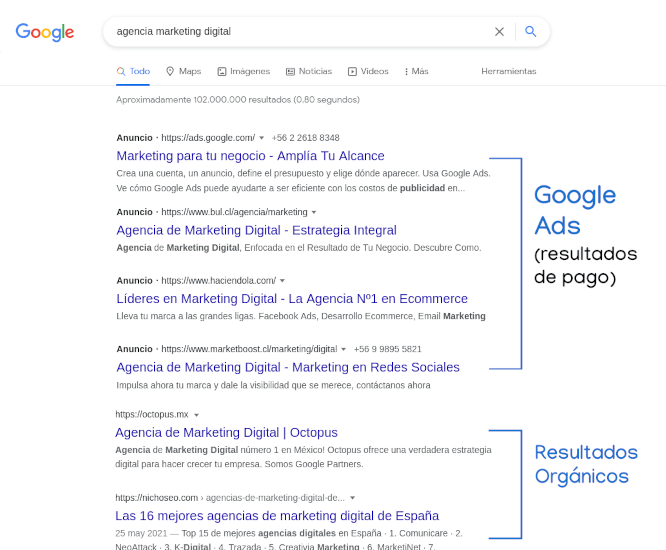
As mentioned above, SEO handles organic results. SEM (Search Engine Marketing), on the other hand, is the discipline that covers paid results. However, despite how widely used the term SEM is, the SEO vs. SEM distinction isn’t entirely accurate — because SEO is also a form of digital marketing. That’s why in online marketing circles, the term SEM is increasingly used interchangeably with pay-per-click (PPC) advertising.
Advantages of SEO over Pay-Per-Click (PPC) advertising
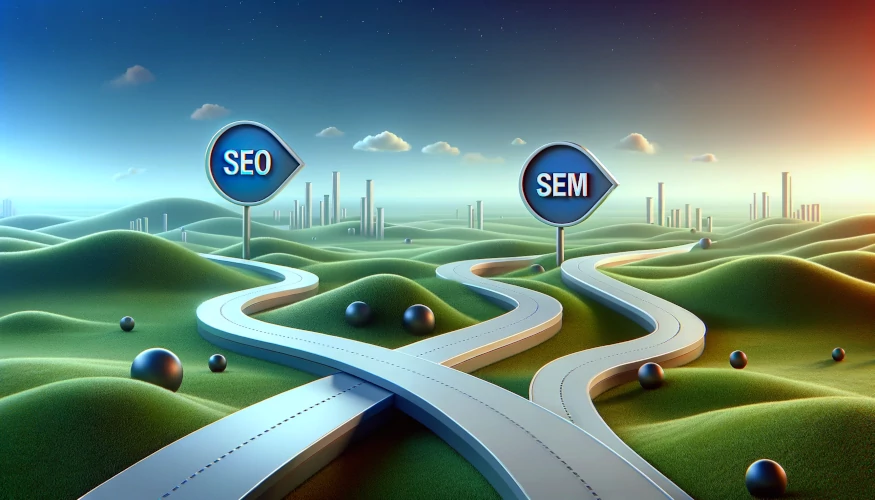
SEO and PPC (or SEM) are often presented as opposing or even incompatible strategies. In reality, both have complementary strengths, and only by using them together — in a coordinated way — can you achieve the best possible results in search engines.
We’ve previously covered the advantages of PPC advertising in our article about Google Ads. On the flip side, here are SEO’s main strengths:
A steady stream of users and potential customers
An SEO campaign typically requires a significant upfront investment — in both time and resources — before results start to materialize. But once they do, the return on that investment is equally substantial. A site that achieves strong search rankings secures a consistent, cost-free flow of potential customers. This, in turn, reduces dependence on paid advertising and allows a website to optimize how it allocates its marketing spend.
Beyond that, SEO strategies allow you to effectively reach a much wider range of users at different points in the buying journey. Because of their costs and the need to remain profitable, PPC campaigns tend to focus on users who are actively searching for a specific product, service, or piece of content. SEO, by contrast, offers an affordable way to reach a larger volume of users in the earlier phases — known as “top of the funnel.” And it’s precisely in those early stages of the customer journey where the greatest opportunities for achieving strong rankings with relatively modest effort are often found.
Imagine a running shoe store. The most obvious customer acquisition strategy is to advertise for terms like “buy running shoes.” But SEO allows the store to reach a much broader group of potential customers through articles like “best exercises for runners” or “footwear tips for runners to prevent injury.” Through those articles, the store can showcase its products and stay on customers’ radar for the moment they’re ready to buy.
These are the strategies that give SEO its greatest power — increasing your site’s visibility throughout the entire customer decision journey, including after the purchase.
Greater credibility and trust
Advertising often carries a slightly negative connotation. Consciously or not, our brains tend to recognize advertising for what it is — an attempt to influence us — and that creates a certain resistance. For the same reason, organic results are often perceived as more trustworthy and relevant than paid ads. That’s because many of us instinctively assume that websites appearing at the top of a search are also the highest quality. As a result, we tend to grant those sites greater credibility and trust — which can significantly help convert visitors into loyal customers.
Uncovering new opportunities
One of the core components of SEO work is the constant research of new trends and opportunities. This means analyzing your competitive landscape but also mining the data generated by your own website. Through this process, you regularly discover that users are landing on your site through terms or topics you never would have anticipated. That information is valuable — it points to new ways of reaching more users, and also to ways of improving and expanding your content and product offerings.
How do search engines decide who ranks first?
This is the million-dollar question. After all, if we know what search engines look for when building their rankings, we can simply adapt our website to meet those criteria and — voilà — our site shoots straight to the number one spot.
Not quite. According to various sources, Google (and by extension other search engines) uses more than 200 signals to rank websites. That exact figure has never been officially confirmed, but the sheer number of criteria involved makes it genuinely difficult to satisfy all of them. On top of that, the exact criteria and the weight each search engine assigns to them are among the most closely guarded secrets in tech — precisely to prevent manipulation. Add the fact that these criteria constantly evolve and that your competitors are doing the same work, and you start to see just how complex SEO really is.
But the goal here isn’t to discourage anyone — quite the opposite. Perfectly optimizing your website for SEO is virtually impossible. What is achievable, however, is progressively improving your site so it steadily climbs toward better and better positions.
It’s easy to lose sight of the big picture when you’re deep in the weeds. Immersed in techniques, ranking factors, and constant algorithm changes, we often forget the obvious: search engines only make sense if they deliver useful, relevant results for what we’re actually looking for. That’s why, regardless of the broader interests that companies like Google and Microsoft may have (such as maximizing advertising revenue), they know it’s essential that their search engines do what they were built to do.
Understanding this simplifies SEO enormously. Because if you keep it in mind, you’ll realize that in essence, every SEO task comes down to one of these three questions:
- Does your website offer useful and relevant information and/or services?
- Is your content, services, and products better than those of similar websites?
And finally — and most importantly. If you answered yes to both questions above: great, you’re on the right track. Your website is the best candidate on the list. But:
- Do the search engines know that?
How to rank on Google (and beyond)
Fair enough — the previous section was a bit abstract, and what you really want to know is how to get your website to the top of Google as quickly as possible. So let’s get practical. Among the many criteria search engines use, a handful of key factors are universally recognized as important. Without trying to be exhaustive — that’s a topic for another article — here are the main points to keep in mind:
Focus on the quality of what you offer
Make sure what your website delivers matches what your potential users are actually looking for, and commit to offering the best information you can. Repeating what everyone else says, in the same way they say it, won’t get you very far. But communicating better than the competition, showcasing what makes you unique, and demonstrating genuine expertise — that will.
Deliver the best possible user experience
Content matters, and so does functionality. No matter how good your offering is, if your website is slow, disorganized, or treats users poorly, they won’t come back. And search engines know it. So make sure your site is fast, secure, easy to understand and navigate, and displays well on any device — desktop or mobile.
Align with what your audience cares about
Research and identify the search terms and topics your potential audience is interested in, and use that insight to expand and improve your content — making it easier to find online. Also, regularly review how users behave on your site. That data will give you clear signals about what’s working and what needs improvement.
Build connections
A website’s reputation is fundamental to achieving strong search rankings. Just as in the real world, your reputation is built on what others say about you. That’s why your chances of growing your search visibility increase when other websites and users share and link to your content. When they do, search engines interpret that as a signal that your site is trustworthy and your content is valuable — especially if the linking site is itself well established in the search rankings.
So remember: the internet is a network. Take every opportunity to connect with related websites and your own users — through collaborations, or by sharing your knowledge and content in forums, on social media, and through similar channels.
Make your site visible to search engines
Even though search engines are getting better at interpreting content the way a person would, they still need help discovering new sites and understanding what they offer. That’s why it’s important to submit your site to search engines and provide key information through a sitemap, while using your target search terms in headings, body content, page URLs, and meta tags.
Not sure what half of that means? Don’t worry — we’ve all been there. Making your site visible to search engines is, without question, the most technical and intimidating part of SEO. But there’s an enormous amount of information online about each of these topics, and step by step, you’ll soon realize you’ve made more progress than you expected.
The best time to start with SEO is right now
What you know right now matters less than you think — because what truly counts is getting started as soon as possible. SEO never ends. Search engines, competitors, and even your audience are constantly evolving. That said, the hardest stretch is between zero and your first strong rankings. It’s easy to feel disheartened and give up during that phase — and most websites do exactly that.
On the other hand, while becoming a skilled SEO professional requires a wide range of knowledge, nothing says you need all of it before you begin. So if you focus on making your website a little better every day, you’re already on the right path. There’s a mountain of information online about every aspect of SEO you can imagine. Pick one area, learn about it, and apply it to your site. A few months from now, if you stay consistent, you’ll be surprised by how much ground you’ve covered. So start today: improve your page titles, learn how to find and analyze keywords, or make your site a little faster. SEO takes consistency and patience. If you want a strong presence in search engines, the best thing you can do is start now. So what are you waiting for?