The primary goal of any online marketing specialist is to capture the attention of potential customers. In a search results environment saturated with information — where attention and patience are in short supply — appearing at the top of the page is essential. But Google has been changing for a while, and it’s getting harder to pin down what “top positions” actually means — or, in the case of ads, what “top of the search results” really refers to.
In search marketing, visibility is everything. There’s no point having the best product or the cleverest ad copy if nobody sees it. Most of us, when we search on Google, focus our attention on the first few results. As a consequence, results at the top of the page are not only the most seen — they’re also the most clicked. According to research by FirstPageSage and Backlinko, the top organic results (i.e., non-paid) capture just over half of all clicks. The same dynamic plays out in advertising: a higher ad position significantly increases the likelihood that users will visit your website.
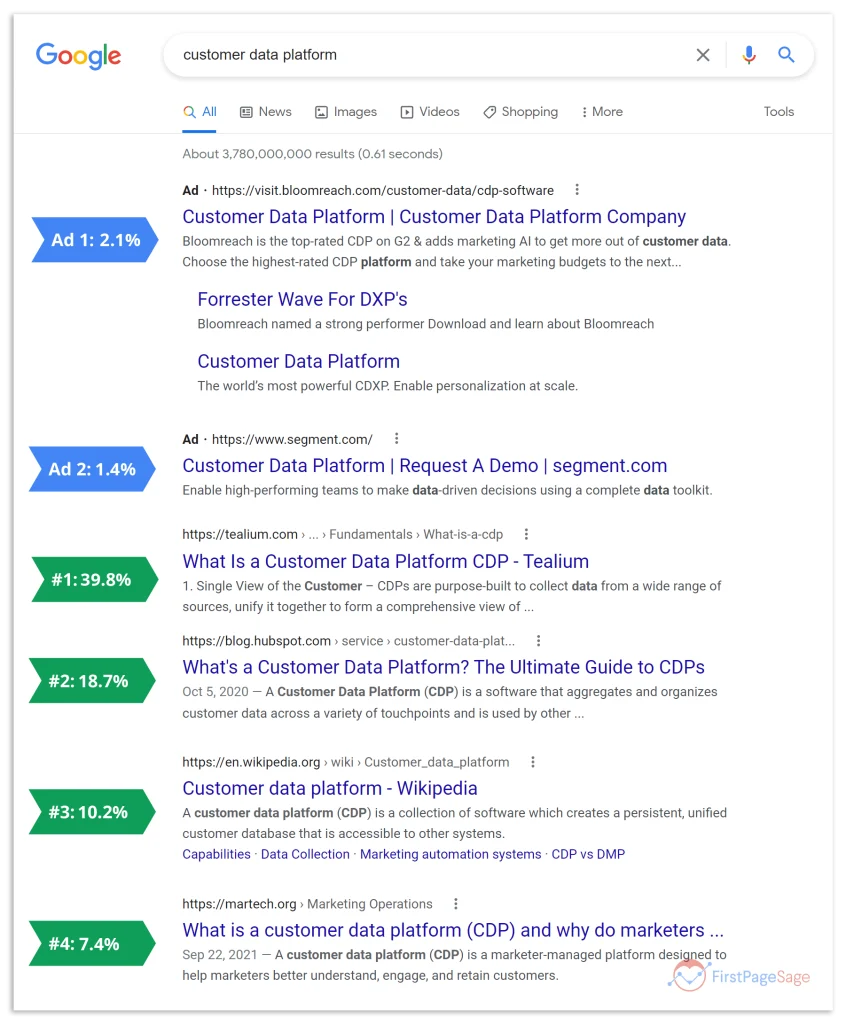
CTR by search result position by FirstPageSage
When we think of “top,” we naturally picture whatever is highest on a page. But for ads running through Google Ads, that’s no longer necessarily the case — Google has updated the definition of “Top Ads” in its Help Center:
“Top ads are adjacent to the top organic search results. Top ads generally appear above the top organic results, though top ads may appear below the top organic results for some queries. The position of ads at the top is dynamic and may change based on the user’s search.”
Google, Help Center
This updated definition is meant to better reflect how top ads actually appear on the page. Over recent years, snippets and rich results (featured paragraphs, lists, recipes, and more) displayed at the top of the page have been steadily eating into the visibility of traditional search results. This trend will likely accelerate as SGE (Search Generative Experience) — Google’s AI-generated answers — continues to gain prominence.
One consequence of this change is that metrics related to top-of-page ads become less reliable for estimating an ad’s actual position and therefore its visibility. If you notice that your ads start receiving fewer clicks despite apparently appearing in the “top” position, there’s a real possibility they’ve been pushed down by other types of search results.
But if Google earns most of its revenue through advertising, why would it reduce ad prominence? Despite appearances, this change could actually point in the opposite direction — aimed at increasing ad effectiveness and click generation, ultimately growing revenue for Google. According to Search Engine Land, the update to the “Top Ads” definition is actually a signal that Google plans to insert paid results between organic results in the future, as shown in this screenshot:

Ads interspersed with organic search results, screenshot by Patrick Stox
If this change goes live, ads will likely become harder to distinguish from organic results. This would lead more users to click on paid links, generating more traffic for advertisers — but also increasing campaign costs. The open question is whether more visits will actually translate into better results for advertisers. For that, we’ll have to wait and see whether the change becomes a reality.